 EN
EN
What filter matching rule for dust proof cabinet cooling fan operating in cement factories
2026/09/30
Cement cabinets choke on dust. Learn the filter rule for an industrial cabinet cooling fan: G4/F7 media, IP rating, and pre-filter care.

2026/10/03
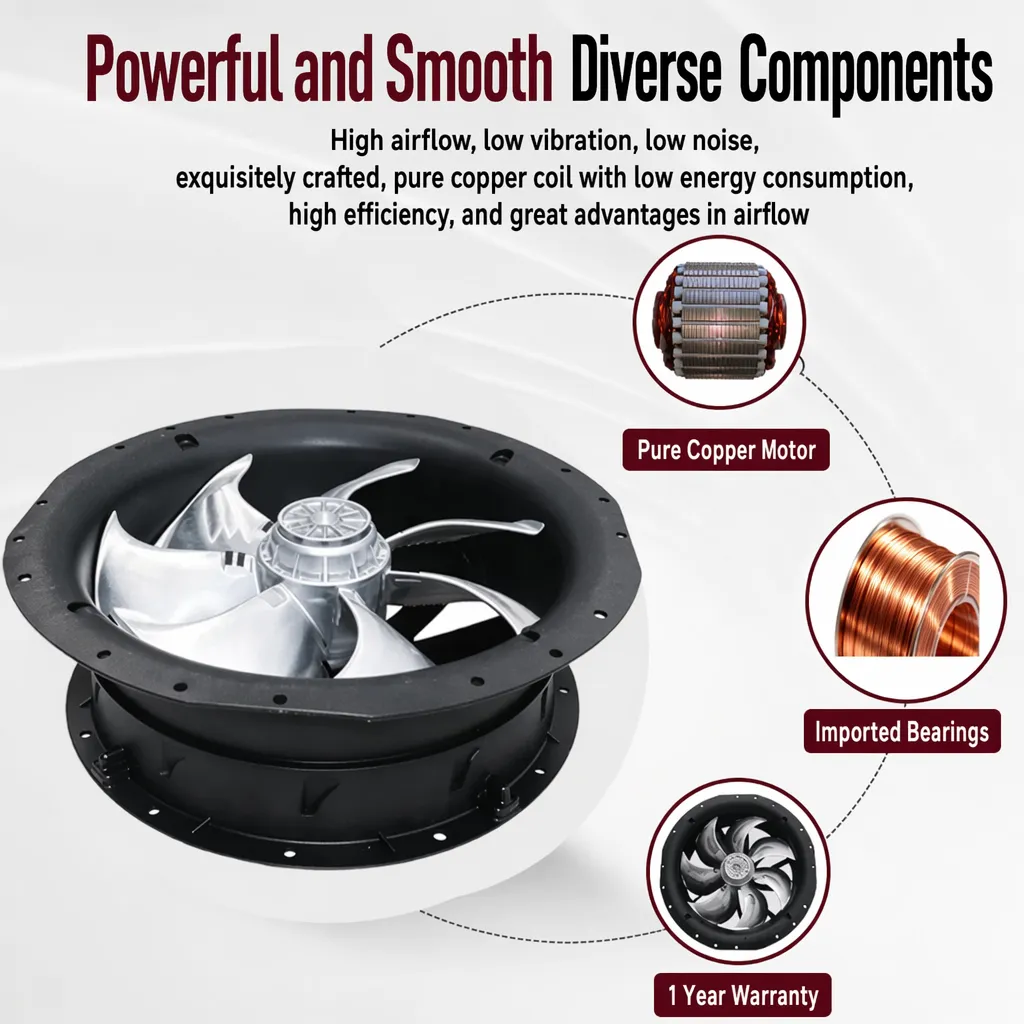
The large centrifugal fan earns its place on the supply side because centrifugal action converts motor speed into usable pressure. Unlike a simple axial unit that throws air a short distance, a centrifugal machine sustains airflow against duct resistance and filter loading. In a 50,000 m² envelope the supply air must travel far from the wall plenum to the picking aisles, so the fan needs pressure reserve. Lobisong double-inlet centrifugal families use pure-copper motor windings and imported precision bearings that hold L10 life under continuous duty. The impeller geometry also keeps the noise band manageable, which matters where pickers work eight-hour shifts.
Consider a regional e-commerce fulfillment center exceeding 50,000 m². Background: the facility moves parcels constantly. Problem: every open dock door lets a curtain of 32 °C outdoor air rush in while conditioned air escapes, lifting floor temperature near the docks. Solution: engineers placed high-volume supply fans on the opposite wall and ran them counterflow to the exhaust, so make-up air arrived before the heat column reached the aisles. Effect: dock-adjacent pick zones stayed in the comfort band and the building did not rely on refrigeration alone. This shows why supply pressure must be planned, not guessed.
Exhaust and supply are a married pair. If exhaust outruns supply, the building sits in negative pressure and outdoor air leaks in through every gap, defeating the ventilation plan. A balanced design keeps supply within a few percent of exhaust so dock doors open against neutral pressure. Backpressure from long duct runs and filtration must be measured during commissioning, and the centrifugal supply units should be selected on the system curve, not on free-air CFM alone. The centrifugal supply fan matched to that curve holds neutral pressure even as filters load and duct static pressure drifts. CE and UKCA marked fans give buyers documented performance points to verify against the spec sheet.
Make-up air volume should track the exhaust volume with a margin for door infiltration. A practical rule keeps supply at roughly 90–100 percent of total exhaust, then trims with CO₂ or temperature sensors. Undersizing leaves stale pockets; oversizing wastes energy and creates drafts at workstations. ASHRAE and OSHA guidance on indoor air quality sets the intent, while ISO 5801 gives the standardized fan test method so quoted airflow figures mean the same across suppliers. Scheduling the two streams together prevents the short-cycling that wears bearings and motor windings. A centrifugal supply fan delivering this matched volume needs the pressure reserve to push air to distant aisles without starving the docks.
Warm air from rooftop solar gain and equipment naturally rises, but in a tall clear-height warehouse it can stall against the roof and form a hot stratified layer. A centrifugal supply fan cannot correct this if its discharge sits at the ceiling, since the supply then joins the hot layer. The stack effect then pulls cooler floor air upward through open racking, leaving pickers in a tepid band while the ceiling soaks heat. Without intervention the stratification wastes both fan energy and cooling capacity because thermostats read the wrong layer.
A large centrifugal fan on the supply side breaks stratification by directing tempered air at low level and letting it lift gradually through the space. Placing supply diffusers near the floor and exhaust high on the opposite wall encourages a full-volume exchange rather than a ceiling-only loop. Duty cycling the supply in step with the heat load keeps the exchange rate honest without running flat-out all day. The result is a stable vertical temperature profile that protects both product and people.
A variable frequency drive lets the centrifugal supply fan follow the real load: full speed during peak inbound shifts, reduced speed overnight when only automated storage runs. This part-load control trims kWh without starving the aisles of air. Energy scheduling tied to the warehouse management system can pre-cool before the morning surge, so the fan ramps from low RPM instead of a hard start that stresses the motor. EC and brushless outer-rotor options extend this further with closed-loop speed feedback.
Before specifying a large centrifugal fan, procurement engineers should verify the enclosure rating (IP44 on several series), the bearing type, and the motor insulation class, then request CAD drawings and parameter sheets. During operation, inspect impeller balance, listen for bearing tone, and clean filters on a fixed calendar so static pressure stays in range. A simple log of RPM, current draw, and supply temperature trends catches drift early. Following a short checklist protects the ventilation investment and keeps the airflow field predictable for years.
Ventilating a super-large logistics warehouse demands more than moving air; it requires balancing exhaust with make-up air, fighting heat stratification, and scheduling the load. A large centrifugal fan on the supply side gives the static pressure to reach distant aisles and the control headroom for duty cycling. In logistics warehouse ventilation, the exhaust side must be equally matched, so a high volume exhaust fan should be sized against the same system curve as the supply unit. Specify on the system curve, verify CE and UKCA documentation, and maintain the impeller and bearings on a calendar. These principles hold for any big space ventilation project, where industrial warehouse air exchange depends on balance rather than raw fan count.
Frequently Asked Questions
Question
What ventilation rate does a super-large logistics warehouse need?
Answer: Industrial warehouse air exchange targets depend on occupancy, equipment heat, and dock-door traffic rather than a single fixed number. A practical starting point tracks total exhaust and adds margin for infiltration, then trims with CO₂ and temperature sensors. ASHRAE and OSHA indoor air quality guidance sets the intent, while ISO 5801 standardizes how suppliers report airflow so quoted figures stay comparable during procurement. In logistics warehouse ventilation, this measured approach beats a rule-of-thumb air-change number.
Question
Why must make-up air volume match exhaust volume?
Answer: Balanced flows keep the building near neutral pressure so outdoor air cannot leak through gaps and defeat the plan. When a high volume exhaust fan outruns supply, negative pressure pulls humid, dusty air in around dock doors and raises cooling load. Sizing make-up air to roughly 90–100 percent of exhaust, then fine-tuning with sensors, protects air quality and prevents the drafts that disturb pickers and damage stored goods. This balance is the foundation of effective big space ventilation.
Question
How does a large centrifugal fan reduce heat stratification?
Answer: A large centrifugal fan on the supply side directs tempered air at low level, letting it rise gradually through the space instead of joining the hot ceiling layer. Placing diffusers near the floor and exhaust high on the opposite wall drives a full-volume exchange. Duty cycling the supply with the heat load keeps the exchange honest. The result is a stable vertical temperature profile that protects product and people, and it is why logistics warehouse ventilation favors centrifugal supply over simple axial exhaust.
Question
Can duty cycling cut logistics warehouse ventilation energy cost?
Answer: Yes, when the supply large centrifugal fan follows the real load instead of running flat-out. A variable frequency drive ramps speed to match shift heat, pre-cooling before surges and dropping to low RPM overnight. This part-load control trims kWh without starving aisles of air. Pairing scheduling with the warehouse management system avoids hard starts that stress the motor and short-cycle the bearings, extending service life. For industrial warehouse air exchange, duty cycling is the single biggest energy lever after flow balance.
Question
Do logistics warehouses need CE or UKCA marked fans?
Answer: For exports to Europe or the United Kingdom, CE and UKCA marking confirms the large centrifugal fan and any high volume exhaust fan meet documented safety and performance requirements buyers can verify. Marked units arrive with parameter sheets and CAD drawings that simplify commissioning. While local codes vary, selecting marked equipment reduces compliance risk and gives procurement a consistent baseline for big space ventilation. Always request the declaration of conformity alongside the test data before finalizing the purchase order.

2026/09/30
Cement cabinets choke on dust. Learn the filter rule for an industrial cabinet cooling fan: G4/F7 media, IP rating, and pre-filter care.

2026/10/07
Right wall-mount height for an industrial axial exhaust fan: room volume, free clearance, brackets, and recirculation control.

2026/10/08
An ec motor fan links to BMS via Modbus, 0-10V and PWM for demand-based cooling, energy scheduling and automatic sensor-driven speed control.

2026/10/06
A radial exhaust fan removes grease, fumes, and odors from food-processing workshops with capture velocity and hygienic washdown design.

2026/10/05
Learn antistatic treatment for industrial cabinet cooling fan in electronics workshops—ESD-safe housing, ionizable plastics, and cleanroom compatibility.

2026/10/04
Discover how a brushless dc servo delivers precise wind speed control for laboratory cooling fans with closed-loop PID feedback and laminar airflow.
