 EN
EN
What filter matching rule for dust proof cabinet cooling fan operating in cement factories
2026/09/30
Cement cabinets choke on dust. Learn the filter rule for an industrial cabinet cooling fan: G4/F7 media, IP rating, and pre-filter care.

2026/09/22
A sterile pharmaceutical workshop lives or dies by its air. Particles, microorganisms and cross-contamination threaten every batch, and the ventilation system is the primary barrier that keeps them out. At the heart of that barrier is the backward curved centrifugal blower, a machine whose aerodynamic design suits cleanroom duty better than almost any alternative, because it delivers steady pressure and clean, oil-free airflow over long continuous campaigns.
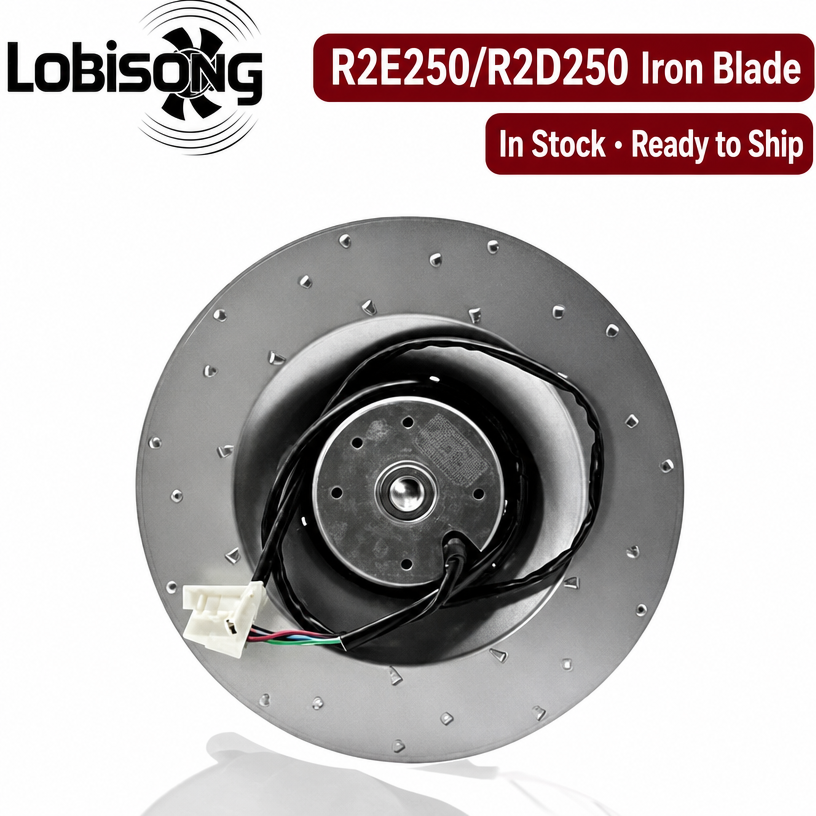
In a backward curved centrifugal blower the blades lean away from the direction of rotation, so air enters axially, turns through the impeller and leaves radially at a stable pressure. This geometry does not stall easily, which means the airflow through filters stays uniform even as filter loading slowly changes resistance. Uniform flow is exactly what a sterile workshop needs, because HEPA filtration and room pressure cascades both depend on a constant volume of air passing through the system.
Clean air requires that the blower adds nothing to the stream. Belt-free direct driven designs eliminate lubricant that could migrate into the airstream, and sealed motor compartments keep carbon dust outside. The backward curved centrifugal blower therefore moves air that arrives at the HEPA filter as clean as it left the room, with the filter doing the final polishing rather than compensating for contamination created upstream.
Sterile workshops hold a staircase of pressures: the cleanest corridor at the highest pressure, changing areas lower, and unclassified spaces lowest. Maintaining each step requires fans that respond precisely to tiny differences, and a backward curved centrifugal blower provides the stable curve that makes such control practical. When a door opens, the airflow through the gap must immediately push back, and only a fan with adequate pressure reserve manages that moment without letting unfiltered air reverse.
Pharmaceutical air change rates are specified per hour and must be demonstrated continuously, not only during audits. The thermal and aerodynamic stability of the backward curved centrifugal blower lets validation teams measure a rate once and trust it for the campaign, because the fan curve does not drift with temperature or hours of operation. This consistency shortens qualification and keeps requalification straightforward.
A buyer specifying a blower for sterile duty should check several points. Confirm the construction materials suit cleaning agents and can withstand wipe-down. Verify motor efficiency class, since these fans run continuously and energy accumulates. Ask for noise data, because operator areas sit close to fan rooms. Confirm the availability of spare impellers and motors with matching curves, and request performance verified at the real system resistance rather than free air, since filters and ducts define the true operating point of every backward curved centrifugal blower in service.
A sterile packaging suite suffered drifting room pressures whenever its old belt-driven supply fans heated up during the day. The replacement project installed direct driven units with backward curved impellers, matched to the existing HEPA housings. Pressure cascades stabilized within a narrow band across the full production shift, smoke studies showed correct airflow direction at every critical opening, and the qualification report documented air change rates consistent from morning to evening, removing a recurring deviation that had troubled previous inspections.
Its non-stalling curve keeps airflow steady against changing filter resistance, which is the defining requirement of filtered cleanroom supply. The backward curved centrifugal blower also runs efficiently at the higher pressures cleanroom systems need, and direct driven versions avoid belt dust and lubricant near the airstream, simplifying contamination control.
By delivering a uniform, pulsation-free flow the blower prevents the mechanical stress that loosens filter media, and by adding no oil or particles upstream it lets the filter work on room air only. A well matched backward curved centrifugal blower also allows pre-filtration to be planned properly, since the fan performance at loaded-filter conditions is known and stable.
Yes, through a supply header with zone dampers, provided the fan has enough pressure reserve for the worst combined demand. Designers model each room's air change requirement and check that the backward curved centrifugal blower curve stays stable when dampers modulate. Redundant fans in N+1 arrangement preserve the cascade if one unit stops for service.
Routine work includes bearing checks, vibration measurement and verification that motor temperature stays within limits, all performed without opening the airstream. Because the backward curved centrifugal blower is direct driven, there are no belts to replace, and service intervals concentrate on monitoring rather than consumables, which reduces the risk of introducing contamination during maintenance.
Validation measures air change rates, pressure cascades and airflow visualization at critical points, then repeats them over time to prove stability. The steady curve of the backward curved centrifugal blower makes these tests repeatable, and commissioning data stored at acceptance becomes the reference against which every future requalification compares, keeping compliance documentation consistent year after year.
Clean air in a sterile pharmaceutical workshop is an engineered outcome, and the backward curved centrifugal blower is the machine that makes it dependable. Stable curves, oil-free airflow and quiet continuous duty let the rest of the contamination control system do its job, batch after batch, with performance that validation teams can measure and trust.

2026/09/30
Cement cabinets choke on dust. Learn the filter rule for an industrial cabinet cooling fan: G4/F7 media, IP rating, and pre-filter care.

2026/10/07
Right wall-mount height for an industrial axial exhaust fan: room volume, free clearance, brackets, and recirculation control.

2026/10/08
An ec motor fan links to BMS via Modbus, 0-10V and PWM for demand-based cooling, energy scheduling and automatic sensor-driven speed control.

2026/10/06
A radial exhaust fan removes grease, fumes, and odors from food-processing workshops with capture velocity and hygienic washdown design.

2026/10/05
Learn antistatic treatment for industrial cabinet cooling fan in electronics workshops—ESD-safe housing, ionizable plastics, and cleanroom compatibility.

2026/10/04
Discover how a brushless dc servo delivers precise wind speed control for laboratory cooling fans with closed-loop PID feedback and laminar airflow.
