 EN
EN
What filter matching rule for dust proof cabinet cooling fan operating in cement factories
2026/09/30
Cement cabinets choke on dust. Learn the filter rule for an industrial cabinet cooling fan: G4/F7 media, IP rating, and pre-filter care.

2026/09/19
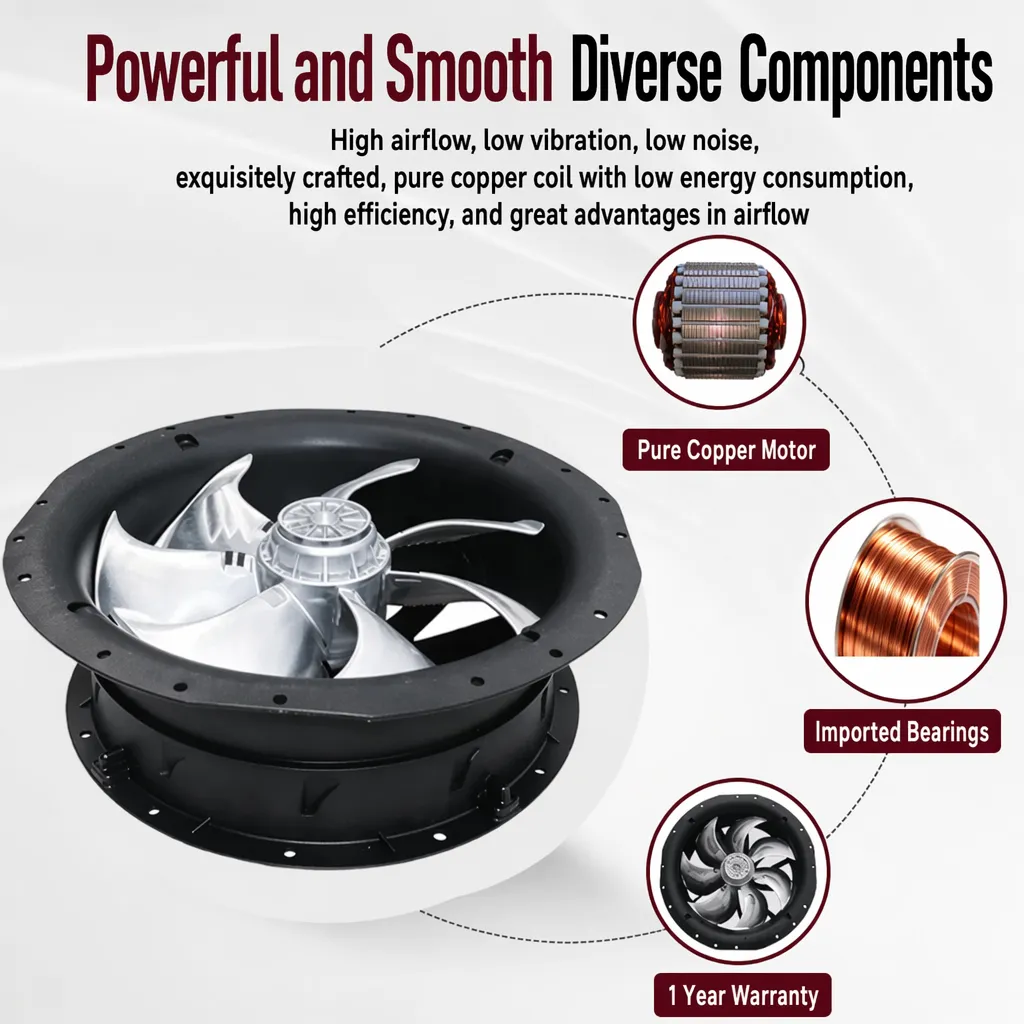
An industrial axial exhaust fan forms the backbone of workshop ventilation, drawing contaminated air away from operators before it spreads. Effective design pairs this equipment with capture hoods and balanced duct airflow to keep harmful gas under control.
An industrial axial exhaust fan cannot clean a workshop by itself; it works only when contaminant-laden air is captured at the point of release. Capture velocity is the minimum air speed needed at a source to overcome thermal plumes, cross-drafts and buoyancy so that solvent mist and vapor move into the hood rather than the breathing zone. A painting line emits thinners, isocyanates and overspray; without adequate capture velocity these pollutants disperse across the bay.
Engineering the capture point starts with a hood placed close to the emission. The fan then sustains the duct velocity required downstream. Realistic capture speeds for painting booths sit in a moderate range; the exact value depends on the room draft and the pollutant density. Undersizing the fan leaves a weak capture zone, while oversizing wastes energy and pulls conditioned air out of the enclosure.
Axial-flow movement relies on a propeller-style impeller that drives air parallel to the shaft. Performance is governed by volume flow against system resistance, expressed as static pressure. When the exhaust duct is long, elbowed or filtered, the required pressure rises and the fan must hold design airflow. AMCA 210 and ISO 5801 define the test method for volume and pressure, giving comparable performance figures.
Pressure balance also protects adjacent rooms. An exhaust that removes more air than the supply delivers creates negative pressure, pulling unfiltered air through gaps. A matched industrial axial exhaust fan keeps the workshop slightly negative yet stable. PMDC and EC drives allow the motor to slow during low-load periods, trimming electricity while preserving capture at the source. A fan curve shows airflow against static pressure; selecting on the curve avoids operation near stall where noise and vibration rise. Regular airflow measurement with a pitot or thermal anemometer confirms the system still meets the design ventilation rate.
Background: a metal-components workshop applied solvent-based coatings on a manual line, with local extraction only at one booth. Problem: operators reported solvent odors and eye irritation; area sampling showed vapor concentrations above the advised control level near the curing racks.
Solution: the team installed an overhead industrial axial exhaust fan rated to the booth volume, paired with a capture hood above the rack and a washable pre-filter. The duct followed a short, low-resistance path to the roof.
Effect: visible mist cleared within minutes of startup, odors dropped sharply, and operator comfort improved. Energy use stayed moderate because the drive tracked the production schedule instead of running flat-out.
OSHA 29 CFR 1910.94 guides ventilation where an industrial axial exhaust fan serves spraying operations, aiming to keep airborne contaminants below exposure limits. A compliant system combines capture at source with sufficient air change so that residual fume is diluted. Ventilation is one control layer alongside respirators and substitution of less hazardous materials.
Documentation matters for audits. Recorded capture velocities, filter change dates and airflow readings demonstrate that the exhaust system performs as designed. Where confined spaces exist, OSHA 29 CFR 1910.146 adds entry controls that interact with the ventilation plan.
NFPA 91 covers exhaust systems where an industrial axial exhaust fan conveys vapors, gases, mists and noncombustible particulate. It addresses construction, access for cleaning and the separation of flammable-residue ducts from ignition sources. In coating and chemical duty, duct interiors collect deposits that can ignite; routine access and wash-down reduce that risk.
For potentially explosive atmospheres, ATEX 2014/34/EU in the EU and UL 507 in North America shape equipment selection. Aluminum or bronze non-sparking impellers lower ignition risk where zones are classified. Zone classification guides industrial axial exhaust fan choice and installation distance.
An industrial axial exhaust fan in chemical duty carries moisture, thinners and acidic mist, so the impeller and housing need corrosion resistance. Galvanized steel suits dry duty; stainless steel 304 or 316 serves aggressive atmospheres; polypropylene resists many acids. For classified zones, aluminum or bronze non-sparking blades are chosen to avoid ignition from contact.
The impeller should be balanced to ISO 1940 grade so vibration stays low at speed. Precision ball bearings and a pure-copper winding outer-rotor motor extend service life under continuous duty. Lobisong supplies matched AC, DC and EC fans and custom builds to unique operating parameters. Scheduled lubrication of bearings and inspection of the impeller for coating loss prevent unexpected downtime. A washable filter screen keeps overspray away from the blades, preserving balance and rated airflow over the service life.
Ratings communicate tested limits. IEC 60529 defines the IP code; an IP54 or IP44 mark shows protection against dust and water ingress for the enclosure. IEC 60034 covers motor efficiency classes, useful where ErP targets apply. CE and UKCA marks appear on compliant Lobisong products for European and British markets; RoHS and REACH confirm material compliance.
Buyers should verify the rating plate, test report and declared performance against AMCA 210 / ISO 5801. Inspect the impeller for balance and the housing for coating integrity before commissioning. During use, log operating hours and pressure drop across the filter to time replacements. A pre-start check of free rotation and unusual sound catches faults early, supporting safe continuous extraction in painting and chemical duty.
Removing harmful waste gas from a production workshop depends on capture at source, balanced duct airflow and standards-based design. A correctly sized industrial axial exhaust fan, matched to NFPA 91 and OSHA expectations and maintained on a schedule, keeps painting and chemical bays safer and more comfortable for the people who work there.
What is capture velocity in industrial ventilation?
Answer: Capture velocity is the minimum air speed at the emission point that pulls contaminant-laden air into the hood before it reaches the breathing zone. It must overcome cross-drafts, thermal plumes and buoyancy from hot processes. Painting and chemical sources need enough capture speed to collect solvent mist and vapor. Correct hood placement and a fan sized to the duct resistance sustain that velocity. Measured values, not assumptions, confirm effective capture.
Why does workshop ventilation matter for operator safety?
Answer: Ventilation removes airborne solvent, mist and vapor that cause irritation, dizziness and long-term health harm. Without extraction, pollutants accumulate near curing racks and spray booths where people work. Capture at source plus adequate air change keeps concentrations below exposure limits referenced by OSHA 29 CFR 1910.94. Good ventilation also reduces fire risk from flammable residues. A safer breathing zone supports steady, productive work.
How does an axial fan extract harmful gas from a workshop?
Answer: An axial fan uses a propeller-style impeller to push air along the shaft and out through the exhaust duct. At the source, a hood and capture velocity draw pollutant air in; the fan sustains duct velocity against system resistance. Filtered pre-cleaning traps overspray. EC or PMDC drives adjust speed to load, saving energy while preserving capture. Performance follows AMCA 210 and ISO 5801 test methods.
Can a single axial exhaust fan serve a whole workshop?
Answer: A single industrial axial exhaust fan can serve one booth or a defined zone sized to its airflow and capture velocity. Large workshops with several emission points usually need multiple hoods and balanced supply air to avoid dead spots. Duct length, elbows and filters raise required pressure, so the fan must meet design flow. Where zones differ in hazard, separate classified systems prevent cross-contamination. Proper layout matters more than fan count.
Do chemical workshops need ATEX-rated exhaust fans?
Answer: Chemical workshops with potential explosive atmospheres need equipment matched to the zone classification. ATEX 2014/34/EU applies in the EU; UL 507 covers North America. Non-sparking aluminum or bronze impellers and isolated motors reduce ignition risk where flammable vapor may appear. CE and UKCA marks confirm compliant Lobisong products. A risk assessment decides the rating. Qualified selection avoids unsafe fans in hazardous duty.

2026/09/30
Cement cabinets choke on dust. Learn the filter rule for an industrial cabinet cooling fan: G4/F7 media, IP rating, and pre-filter care.

2026/10/07
Right wall-mount height for an industrial axial exhaust fan: room volume, free clearance, brackets, and recirculation control.

2026/10/08
An ec motor fan links to BMS via Modbus, 0-10V and PWM for demand-based cooling, energy scheduling and automatic sensor-driven speed control.

2026/10/06
A radial exhaust fan removes grease, fumes, and odors from food-processing workshops with capture velocity and hygienic washdown design.

2026/10/05
Learn antistatic treatment for industrial cabinet cooling fan in electronics workshops—ESD-safe housing, ionizable plastics, and cleanroom compatibility.

2026/10/04
Discover how a brushless dc servo delivers precise wind speed control for laboratory cooling fans with closed-loop PID feedback and laminar airflow.
