 EN
EN
What filter matching rule for dust proof cabinet cooling fan operating in cement factories
2026/09/30
Cement cabinets choke on dust. Learn the filter rule for an industrial cabinet cooling fan: G4/F7 media, IP rating, and pre-filter care.

2026/09/29
Metrology rooms demand environmental stability that goes beyond temperature and humidity. The invisible movement of air itself becomes a measurable force once instruments reach sub-micron resolution, and cooling equipment is frequently the hidden culprit behind scattered data.
A quiet industrial fan addresses the most direct threat: structural vibration transmitted through the floor, duct, and mounting frame. Every rotating impeller produces a periodic force at blade-pass frequency, and when that frequency coincides with the resonant mode of a granite table or air-bearing guide, the CMM probe reads motion that is not there. Cooling airflow should carry heat away, not shake the instrument. Low-turbulence laminar flow keeps the boundary layer calm so the probe arm experiences steady aerodynamic drag instead of pulsing loads that corrupt the point cloud.
Tonal noise is the pure, whistle-like component produced when airflow separates across a sharp trailing edge or interacts with a poorly shaped volute. Unlike broadband hiss, a tone sits at a discrete frequency and can couple into the acoustic enclosure of a laser interferometer or vision system. The result is not just operator annoyance; it is phase jitter in optical measurement. Aerodynamic shaping of the impeller and smooth inlet geometry break up these tones, protecting the signal chain without throttling the required CFM.
Choosing the right low-noise ventilation begins with understanding how energy becomes sound and motion. This section explains the engineering logic behind a vibration-free cooling loop, from impeller aerodynamics to structural decoupling.
When a quiet industrial fan is selected for a metrology room, the impeller profile decides the acoustic outcome. A well-designed blade moves air with minimal separation. Backward-curved profiles and carefully controlled tip clearance reduce the unsteady pressure fluctuations that become both noise and vibration. The goal is a laminar, low-turbulence stream that delivers thermal management without stirring the room. Units are chosen not for peak static pressure but for the smoothest operating point on the curve, where RPM and blade loading stay inside the quiet region. Smooth inlet bells and rounded volutes further suppress tonal generation.
Even a perfectly balanced impeller leaves a residual dynamic force. Isolation mounts, elastomeric or spring elements, decouple that force from the building structure and the instrument foundation. Mounting the unit on a separate inertia base, away from the metrology slab, prevents ground-borne transmission. Cable supports and flexible duct connectors stop the ventilation path from becoming a vibration bridge. These details matter more than raw motor power when the objective is a vibration-free cooling loop beside a sensitive enclosure.
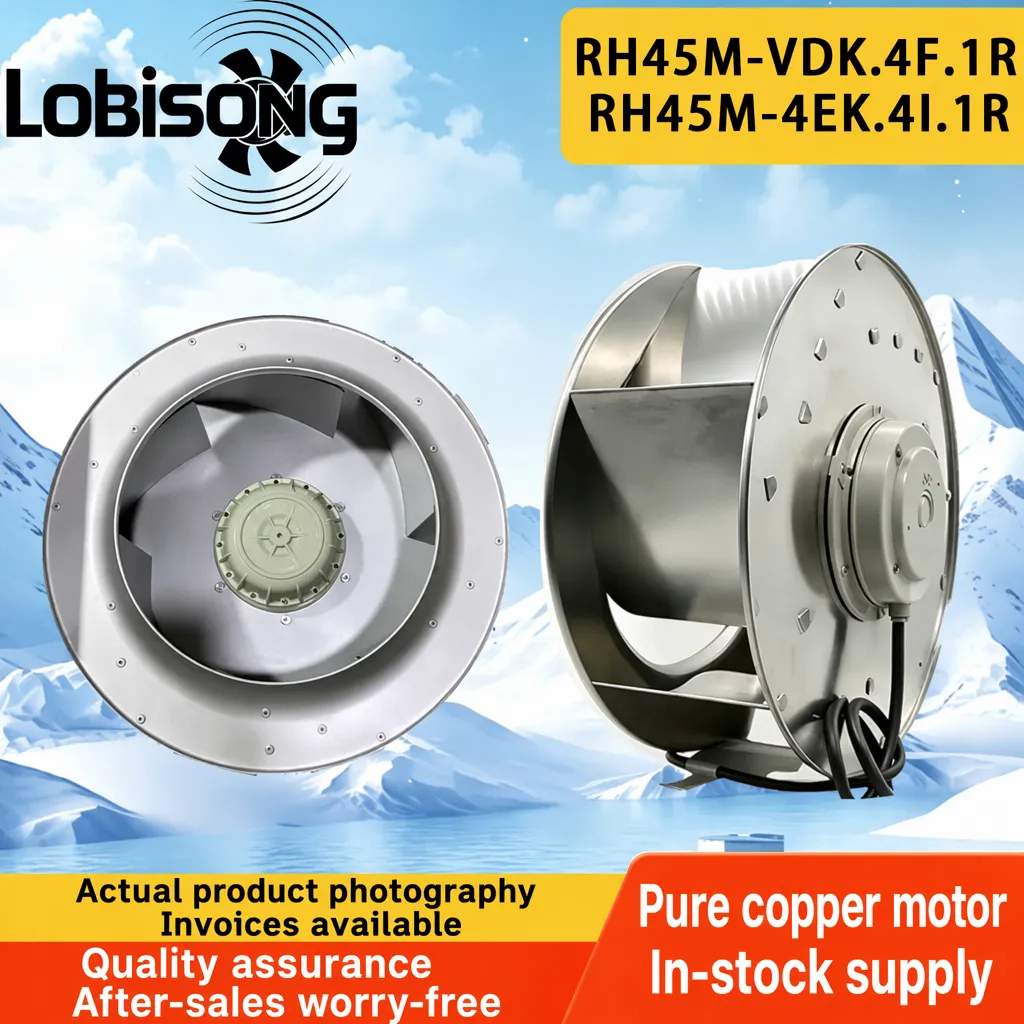
A quiet industrial fan on isolation mounts usually outperforms a comparable axial unit for sensitive rooms because the scroll housing contains and directs energy. A double-inlet centrifugal fan with a brushless outer-rotor motor and pure copper windings runs at lower RPM for the same airflow, dropping both noise and wear. Axial fans still earn their place where throw distance and simple wall mounting win, but for an optical inspection room the centrifugal option usually protects measurement integrity. Match the choice to the room layout, duct length, and backpressure.
Reference experience from precision-component suppliers shows how the right low-noise unit plays out on the floor, following a clear path from background to measured effect.
A precision components manufacturer ran a temperature-controlled room with three CMMs for first-article inspection. Operators reported intermittent out-of-tolerance readings that vanished when the old wall exhaust ran at low speed. The room met cleanroom-class air change targets, yet the data was not audit-ready. Suspecting airflow, the team logged probe deflection against fan RPM and found a clear correlation between tonal peaks and measurement scatter.
The fix replaced the tonal axial exhaust with a new quiet industrial fan on isolation mounts, fed through a flexible duct and a laminar diffuser. A VFD trimmed RPM to the minimum that held the thermal setpoint, and a separate inertia base kept the unit off the metrology slab. Pure copper motor windings and precision bearings stabilized speed under load. The ventilation now delivered the required air changes without a measurable vibration signature at the machine base.
After the retrofit, repeatability studies showed tighter dispersion and far fewer suspect points. Audit reviewers accepted the measurement records without challenge, and the room returned to full first-article throughput. The episode confirmed a simple truth: cooling and metrology are the same system, and acoustic performance is a specification, not an afterthought. Procurement teams now list noise and vibration limits alongside CFM when sourcing ventilation for any precision testing workshop.
Quiet ventilation for metrology is a discipline, not a single product. Specify a quiet industrial fan with documented noise and vibration figures, verify isolation mounts and flexible connectors, and validate the operating point against the room's static pressure. In precision testing ventilation, routine care—bearing inspection, impeller cleaning, and balance checks—preserves the calm airflow that measurement depends on. By treating acoustics as a metrology requirement, precision testing workshops protect both their instruments and the trust their data commands. A low noise workshop fan is therefore specified by its published acoustics, not by its airflow rating alone, and vibration free cooling becomes a measurement prerequisite rather than a comfort preference.
Frequently Asked Questions
Question
What causes measurement drift in a precision testing room?
Answer: Measurement drift in precision rooms usually traces to environmental instability rather than the instrument itself. Airborne vibration from cooling equipment shakes granite tables and air-bearing guides, while tonal noise couples into optical and laser systems. Temperature gradients and turbulent airflow add thermal and aerodynamic load that the probe reads as motion. Controlling precision testing ventilation acoustics, isolating structural paths, and stabilizing the thermal setpoint remove these hidden error sources before they reach the data. This is why a quiet industrial fan is a metrology component, not a utility.
Question
Why does airflow turbulence affect optical inspection accuracy?
Answer: Turbulent airflow creates unsteady pressure on lenses, fixtures, and the measured part, producing micro-motion and refractive index changes that distort imaging. At sub-micron resolution, even a gentle eddy shifts the apparent edge position of a feature. Laminar, low-turbulence flow keeps the optical path stable and the part thermally steady. Selecting smooth inlet geometry and a controlled operating point prevents the pulsing loads that corrupt vision-system measurements in sensitive inspection rooms. For precision testing ventilation, the airflow pattern matters as much as the fan's noise figure.
Question
How can vibration from a fan be isolated from a CMM?
Answer: Isolation starts with decoupling the fan from the building and instrument structure. Elastomeric or spring mounts absorb the residual dynamic force, while a separate inertia base keeps the unit off the metrology slab. Flexible duct connectors and cable supports stop the ventilation path from becoming a vibration bridge. Finally, trimming RPM to the quiet region of the fan curve reduces the excitation at its source, protecting the measurement foundation. This is what vibration free cooling means in practice, and it is why a low noise centrifugal fan is often preferred for precision rooms.
Question
Can standard workshop ventilation meet metrology requirements?
Answer: Standard workshop ventilation rarely meets metrology needs because it is tuned for heat removal, not acoustic isolation. Typical units lack isolation mounts, smooth inlet geometry, and a controlled low-RPM operating point, so they transmit tonal noise and vibration into the room. A purpose-selected low noise workshop fan with documented noise figures, flexible connectors, and an inertia base is the practical route to audit-ready measurement stability. In precision testing ventilation, this upgrade path is the difference between a compliant room and a compromised one.
Question
Do precision testing workshops need special fan certifications?
Answer: Precision testing workshops benefit from fans carrying CE and UKCA marks, which confirm documented construction and electrical safety rather than performance promises. The declared noise and vibration data, IP rating, and traceable parameter sheets matter more. Specifying those figures alongside CFM and static pressure gives procurement a defensible basis, and a quiet industrial fan with published acoustics supports both compliance and measurement integrity. Whether the unit is a low noise centrifugal fan or another low noise workshop fan type, documented acoustics and vibration free cooling performance are the deciding specifications.

2026/09/30
Cement cabinets choke on dust. Learn the filter rule for an industrial cabinet cooling fan: G4/F7 media, IP rating, and pre-filter care.

2026/10/07
Right wall-mount height for an industrial axial exhaust fan: room volume, free clearance, brackets, and recirculation control.

2026/10/08
An ec motor fan links to BMS via Modbus, 0-10V and PWM for demand-based cooling, energy scheduling and automatic sensor-driven speed control.

2026/10/06
A radial exhaust fan removes grease, fumes, and odors from food-processing workshops with capture velocity and hygienic washdown design.

2026/10/05
Learn antistatic treatment for industrial cabinet cooling fan in electronics workshops—ESD-safe housing, ionizable plastics, and cleanroom compatibility.

2026/10/04
Discover how a brushless dc servo delivers precise wind speed control for laboratory cooling fans with closed-loop PID feedback and laminar airflow.
