
 EN
EN
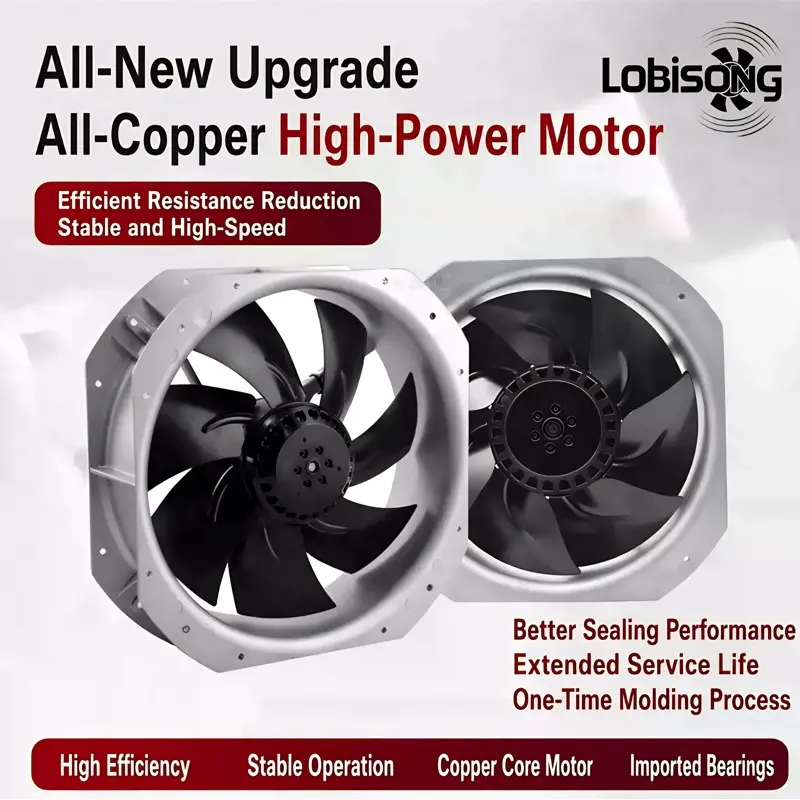
Why External Rotor Backward Curved Fan Outperforms Ordinary Axial Air Mover in Factory Cooling Systems
Have you ever added more axial air movers to a factory floor only to find that temperatures around the heat-generating equipment stayed stubbornly high? That experience is common enough to point toward a pattern: in many cases, it signals a mismatch between fan type and the actual airflow demands of the space. When engineers look more closely, an external rotor backward curved fan turns out to be the more appropriate solution for concentrated industrial cooling.
This article compares the two technologies across the dimensions that matter most in factory environments: pressure handling capability, energy efficiency, noise output, installation practicality, and long-term maintenance burden. The goal is not to declare one type universally superior, but to give you a clearer framework for selecting the right fan for your specific application.
Understanding the Two Fan Types
An axial air mover moves air parallel to its rotating axis, using propeller-style blades. These fans are widely adopted because they are compact, cost-effective, and capable of delivering high air volumes against low resistance — think open warehouse ventilation, general circulation, or spot cooling where there are no significant obstacles to airflow.
An external rotor backward curved fan belongs to the centrifugal family. The motor is built directly into the impeller hub — a configuration called the external rotor — which removes the need for a separate shaft, belt, or coupling. Backward-curved blade geometry directs air radially outward through the impeller, generating notably higher static pressure than an axial design of comparable size. This characteristic makes the external rotor backward curved fan well suited to ducted systems, heat exchange units, air handling equipment, and any installation where the airflow path carries measurable resistance.
Head-to-Head Comparison Across Key Dimensions
1. Static Pressure and Airflow Pattern
This is where the difference becomes most visible in factory cooling scenarios. Axial air movers work well in free-air or lightly restricted environments. Their performance falls sharply when system resistance increases — ducting, filters, bends, and dense equipment racks all add resistance that axial designs struggle to overcome.
Backward-curved centrifugal fans are designed for high-resistance systems. Quality designs routinely reach 75–85% static efficiency at their operating point, compared to considerably lower figures for axial air movers in equivalent ducted installations. A correctly sized external rotor backward curved fan holds its rated airflow even when the system pressure curve shifts — a characteristic often described as "non-overloading," meaning power draw does not spike as resistance increases.
When your cooling challenge involves dense machinery, enclosed compartments, or ducted delivery to specific hotspots, the static pressure advantage of a high airflow backward curved blower is not a marginal benefit — it addresses a fundamental capability gap that an axial air mover simply cannot fill.
2. Energy Efficiency in Sustained Operation
I used to assess industrial fans mainly by rated airflow; over time I found that efficiency at actual operating conditions matters far more than the peak figure on the datasheet. In a factory running fans for 16–24 hours a day, a 10–15% efficiency gain translates directly into energy savings across the equipment lifecycle.
Backward curved fans generally operate at 70–85% efficiency over a wide range of operating points. An external rotor backward curved fan fitted with an EC (electronically commutated) motor can push that figure above 90%, outperforming conventional AC induction-driven axial air movers by a clear margin. For buyers supplying the European market, these efficiency levels align with ErP directive compliance requirements — a concrete factor for trading companies working with European OEMs or installers.
3. Noise Profile
Axial air movers tend to produce elevated tonal noise from blade passage frequencies — a characteristic that becomes more noticeable at higher speeds. Backward-curved impellers, by contrast, have a smoother aerodynamic profile that generally produces lower broadband noise at comparable airflow rates. The external rotor motor configuration in an external rotor backward curved fan reduces mechanical noise further by removing belt drives and shaft couplings, which are common vibration sources in conventional motor-fan assemblies.
In factories adjacent to offices, testing areas, or noise-sensitive workstations, this distinction matters for worker comfort and for meeting occupational noise standards.
4. Installation and Maintenance
Datasheets capture performance under standard conditions. In real factory installations — with varying ambient temperatures, dusty air, and constrained mounting positions — the external rotor motor design holds a practical edge. The motor is built into the impeller, keeping the assembly compact and requiring no external motor mounting, alignment, or belt tensioning.
Maintenance demands for the external rotor backward curved fan are lower than for belt-driven alternatives: no belts to replace, no couplings to realign, no separate external bearing housings to service. For maintenance teams managing multiple ventilation units, this reduction in routine service tasks adds up over time.
If your factory has an open floor plan with minimal duct resistance, axial air movers handle basic circulation adequately — but when heat concentrates around dense machinery or duct-connected equipment, the maintenance profile of the external rotor backward curved fan becomes an additional point in its favor.
5. Application Fit Summary
| Factor | Axial Air Mover | External Rotor Backward Curved Fan |
|---|---|---|
| Static pressure capability | Low to medium | Medium to high |
| Efficiency in ducted systems | Moderate | High (70–85%+) |
| Non-overloading characteristic | No | Yes |
| Noise level at high load | Higher | Lower (broadband) |
| Installation compactness | High | High (external rotor design) |
| Maintenance burden | Medium | Low (no belt/coupling) |
| ErP/energy compliance | Standard | Achievable with EC motor version |
When the External Rotor Backward Curved Fan Is the Right Choice
The external rotor backward curved fan is the stronger selection when your factory cooling requirement includes any of the following:
- Ducted air delivery to specific zones or equipment enclosures
- Heat exchange units where airflow must overcome coil and filter resistance
- Industrial control panels or server rooms requiring sustained static pressure
- Long-term energy consumption as a total cost of ownership factor
- Low noise output alongside effective cooling performance
For open-space circulation in areas without meaningful airflow resistance, an axial air mover remains a practical tool. The key is matching fan type to the system resistance profile — not chasing the highest airflow rating on paper.
Conclusion: Matching Fan Technology to System Requirements
For years I defaulted to selecting the highest airflow fan available for factory cooling assignments. A few field observations changed that habit: oversized axial fans running at high speed generate noise, draw more energy than needed, and still cannot resolve cooling problems rooted in system resistance rather than insufficient total airflow. Shifting to a ventilation backward curved blower with a correctly sized static pressure rating — combined with sound duct design — delivers better thermal results at lower operating cost.
Understanding backward-curved impeller geometry, and how the external rotor motor configuration enables a compact, efficient, and low-maintenance assembly, supports more accurate decisions in factory cooling design. The objective is matching the fan's pressure-flow curve to the real system curve — and for ducted or resistance-heavy factory cooling applications, an external rotor backward curved fan fulfills that requirement more reliably than an ordinary axial air mover.






