 EN
EN
What filter matching rule for dust proof cabinet cooling fan operating in cement factories
2026/09/30
Cement cabinets choke on dust. Learn the filter rule for an industrial cabinet cooling fan: G4/F7 media, IP rating, and pre-filter care.

2026/09/23
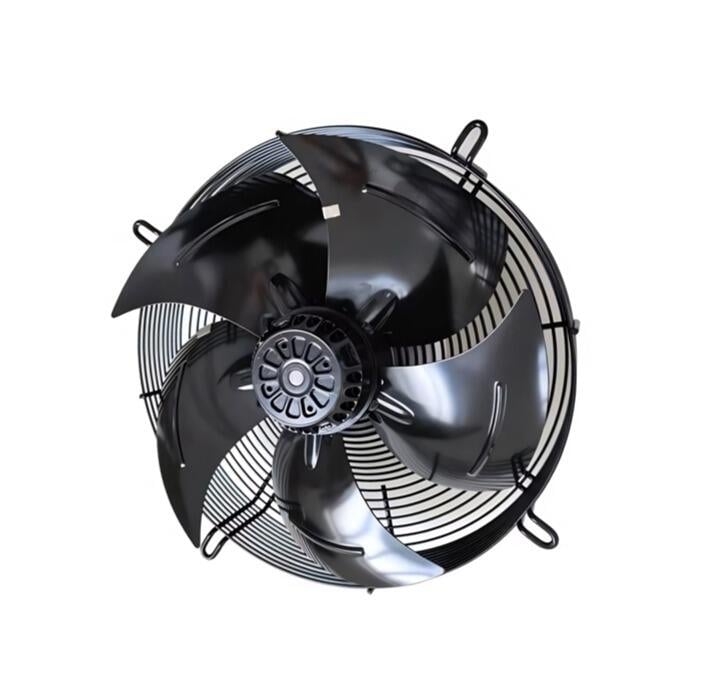
Moving air through a narrow, enclosed run is harder than it looks. A tube axial flow fan pushes air along the axis of its housing and fits directly inside a pipe or ventilation duct, which makes it the standard choice when space is tight and the air path is fixed. Confined pipeline ventilation depends on predictable throughput, so understanding the physics behind inline airflow helps engineers avoid undersized units and chronic pressure losses.
A tube axial flow fan uses an axial blade set mounted on a central hub inside a cylindrical shell, so air enters and leaves parallel to the shaft. The compact housing lets the unit sit inside existing ductwork without bulky scroll casings. Blade pitch and chord set the angle of attack; a steeper pitch moves more air but raises the load on the motor. Precision ball bearings and pure-copper windings keep the rotor balanced, which limits vibration when the inline fan runs for long shifts inside a confined space.
Tip clearance between the blade and shell should stay tight; a wide gap lets high-pressure air slip back to the inlet and cuts efficiency. A low hub ratio moves more volume at lower pressure, while a larger hub trades flow for thrust in dense, resistant ductwork.
Every elbow, filter, and length of pipe adds resistance, and that resistance becomes a pressure drop the fan must overcome. In a long ventilation duct, small kinks compound into meaningful losses. A tube axial flow fan sustains a roughly constant volume against moderate system resistance, which is why it suits pipeline ventilation better than a simple propeller in open air. Lining the ductwork or enlarging the run near the fan reduces turbulent eddies that waste energy.
Specifiers also weigh noise, since a confined space amplifies tone from an unbalanced wheel.
A fan curve plots pressure against flow; the system curve plots the duct's resistance. Their crossing point is the operating point. If airflow resistance is higher than expected, the tube axial flow fan slips left and delivers less air. Sizing should account for fouled filters and future extensions, not just today's clean ductwork. Standards such as ANSI/AMCA 210 define how to test performance so quoted figures mean the same in any plant.
Static pressure, not total pressure, drives air through a resistive network, so compare like for like. A steep system curve from long ductwork meets the fan near its peak, leaving little spare headroom for clogging. Field verification beats catalog trust every time.
A chemical plant ran solvent vapor through a 60-meter pipeline ventilation loop with poor turnover. The line fed a confined space where gas concentration drifted toward the OSHA permissible exposure limit. An open propeller could not hold steady flow against the duct's bends. Engineers installed a tube axial flow fan with an IP54 sealed motor inside the ventilation duct, matched to the measured system resistance. Turnover rose, vapor levels stayed within OSHA limits, and the compact housing fit the tight riser without rebuild.
The maintenance team logged flow weekly and confirmed the inline fan held setpoint through summer peaks.
Confined-space work draws on OSHA 29 CFR 1910.146 for entry practices and on ISO 14644 where clean airflow matters. For electrical safety in damp duct runs, CE and UKCA markings confirm documented compliance. Where ducts carry combustible dust, NFPA 70 (NEC) and ATEX zones set the rules for spark-resistant construction. A duct fan specified against the right standard passes a real inspection instead of only a bench test.
Inspect the nameplate for voltage, IP rating, and certification marks before purchase. Confirm the flange dimensions match the ductwork so the inline fan seats without adapters. Check that the axial blade material suits the gas—coated steel for mild corrosion, stainless for acidic streams. Ask for the test report referenced to ANSI/AMCA 210 and verify bearing type. A documented repeatable build under ISO 9001 signals consistent quality across batches, and a tube axial flow fan from such a line gives predictable duty.
Request spare blade sets and confirm lead time before committing, since a stalled line costs more than the unit itself. Review the wiring diagram to match the site supply and avoid field rewiring.
Run the inline fan within its rated voltage and avoid throttling that pushes the operating point into stall. Monitor amp draw; a rising trend signals clogging or bearing wear. In pipeline ventilation, balancing several branches keeps the flow even instead of starving the farthest vent. Document the baseline so deviations show up early. Keeping the ventilation duct sealed at joints prevents bypass leaks that quietly cut delivered air, so a tube axial flow fan holds its rated output shift after shift.
A simple routine protects steady output. Wipe the axial blade and housing every quarter to clear dust that quietly raises airflow resistance. Verify bolt torque on the compact housing so vibration stays low. Listen for bearing noise and replace parts before failure. Test motor current against the nameplate and keep the surrounding ductwork clean. These steps keep a tube axial flow fan delivering stable air to confined pipeline spaces long after install, turning a one-time purchase into dependable daily ventilation with low lifecycle cost.
What is an inline duct fan used for in industrial pipelines?
Answer: A tube axial flow fan moves air inline through pipes and ductwork where space is confined and the path is fixed. It delivers steady, directional flow for pipeline ventilation, fume extraction, and process cooling. The cylindrical, compact housing slips inside an existing ventilation duct without a bulky casing. Specifiers choose it when moderate pressure must be held against system resistance across long, bent runs.
Why does pressure drop matter when sizing an inline fan?
Answer: Pressure drop is the loss a fan must beat to move air through elbows, filters, and long ductwork. If the loss exceeds the unit's capability, delivered flow falls and the confined space stays poorly ventilated. Sizing only from the clean-duct condition hides future clogging. A correct fan-curve match against measured system resistance prevents an undersized selection. Keep margin for fouled filters and added branches so steady throughput holds.
How should a duct fan be installed inside existing ductwork?
Answer: Seat the inline fan between flanges so the airflow direction arrow matches the duct. Use gaskets at joints to stop bypass leaks that cut delivered air. Keep straight runs of at least one diameter before and after the wheel to protect the axial blade from skewed inflow. Confirm voltage and IP rating suit the environment, then bolt the compact housing firmly. A secure mount limits vibration and keeps the pipeline ventilation stable over time.
Can a tubeaxial unit replace an open propeller in a confined space?
Answer: Yes, where steady directional flow matters more than raw free-air volume. A tubeaxial unit sits inside the ductwork and holds pressure against system resistance, while an open propeller loses output to recirculation in a confined space. The compact housing also shields the wheel and meets IP ratings for damp lines. Confirm the electrical class matches the area, then the inline fan gives controlled pipeline ventilation rather than turbulent, uneven movement.
Where should airflow resistance be measured for accurate sizing?
Answer: Measure at the worst realistic condition: filters loaded, dampers set, and all planned branches open. Read static pressure at the fan location and along the longest ventilation duct run to capture total loss. Match those figures to the fan curve instead of catalog clean-sheet numbers. Involving the operating team during the survey catches hidden bends. Accurate system resistance data prevents both undersized and oversized inline fan choices.

2026/09/30
Cement cabinets choke on dust. Learn the filter rule for an industrial cabinet cooling fan: G4/F7 media, IP rating, and pre-filter care.

2026/10/07
Right wall-mount height for an industrial axial exhaust fan: room volume, free clearance, brackets, and recirculation control.

2026/10/08
An ec motor fan links to BMS via Modbus, 0-10V and PWM for demand-based cooling, energy scheduling and automatic sensor-driven speed control.

2026/10/06
A radial exhaust fan removes grease, fumes, and odors from food-processing workshops with capture velocity and hygienic washdown design.

2026/10/05
Learn antistatic treatment for industrial cabinet cooling fan in electronics workshops—ESD-safe housing, ionizable plastics, and cleanroom compatibility.

2026/10/04
Discover how a brushless dc servo delivers precise wind speed control for laboratory cooling fans with closed-loop PID feedback and laminar airflow.
