 EN
EN
What filter matching rule for dust proof cabinet cooling fan operating in cement factories
2026/09/30
Cement cabinets choke on dust. Learn the filter rule for an industrial cabinet cooling fan: G4/F7 media, IP rating, and pre-filter care.

2026/09/02
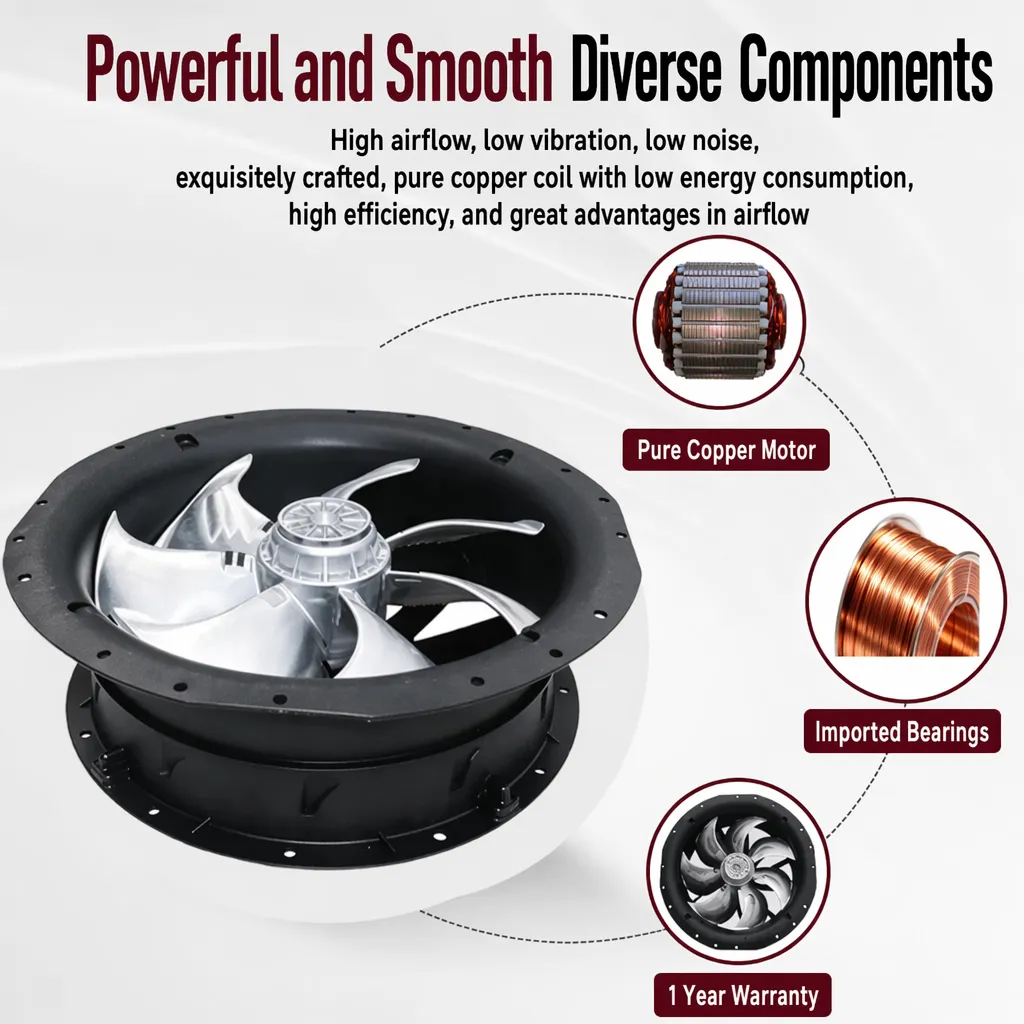
Inside a modern high‑density data hall housing hundreds of active server racks, thermal energy builds up with alarming speed. When localized heat cannot escape fast enough, server processors automatically throttle performance to prevent physical damage, causing severe latency and hardware downtime. Facilities engineers often assume that recurring thermal spikes stem from inadequate chiller capacity. In reality, the root cause is almost always poor air distribution across the facility floor.
Efficient thermal management is primarily a fluid dynamic challenge rather than a simple mechanical refrigeration problem. Standard air conditioning units can freeze the supply air, but without robust volumetric movement, that chilled air never reaches the core of dense rack matrices. Integrating large axial fans into the primary air handler configuration solves this mass‑flow bottleneck, providing the massive volumetric air exchange needed to keep high‑density servers running stably under max processing loads.
Cooling a modern computing environment requires moving vast masses of air to continuously carry away heat generated by high‑density processing racks. Achieving this requires substantial cubic‑meter throughput rather than simply driving small fans at excessive speeds. A high flow axial fan is designed specifically for this purpose, delivering exceptional air volume against low‑to‑moderate static resistance with optimum power efficiency.
Deploying these units in an organized fan array or fan wall configuration satisfies the huge volumetric demands of modern data center cooling without suffering the severe energy penalties associated with forcing air through narrow, restricted ductwork. Fan arrays allow multiple units to operate in parallel at their peak aerodynamic efficiency, avoiding the excessive vibration, energy consumption, and high acoustic output of smaller high‑speed blowers running at full tilt.
Moving massive volumes of air is only half the battle; preventing the thermal short‑circuiting of supply and return air is equally critical. Without structured physical separation, large axial fans can end up recirculating hot exhaust air right back into server intakes. Implementing rigid hot aisle containment systems alongside clear ducting channels ensures that conditioned air flows strictly through the processing equipment before returning to the exhaust handlers.
Uniform airflow distribution eliminates localized dead zones where thermal energy accumulates unnoticed. Aligning high flow axial fan arrays directly with contained hot aisles lowers peak rack inlet temperatures dramatically without needing to add extra chiller units. When server room ventilation design prioritizes directional, uniform mass flow, every rack receives consistent cooling regardless of its position in the hall.
Selecting the right airflow architecture depends heavily on total computing density, floor layout, and overall facility scale.
| Cooling Strategy | Volumetric Capacity | Energy Cost per m³ | Flow Uniformity | Ideal Infrastructure |
|---|---|---|---|---|
| Traditional CRAC Only | Moderate | Higher | Variable | Small, Low‑Density Rooms |
| Large Axial Fan Wall | Extremely High | Lower | Excellent | Large, High‑Density Halls |
| Mixed‑Flow Hybrid System | High | Moderate | Good | Compact Retrofit Facilities |
While traditional computer room air conditioning units maintain base humidity and temperature controls, relying solely on CRAC units to push air across wide spaces often leads to hot spots and excessive energy bills. Integrating a dedicated high flow axial fan array into a data center cooling framework ensures that conditioned air is efficiently distributed right to the server intakes, maximizing thermal performance per kilowatt.
Sizing a high‑capacity fan wall requires a precise analysis of total IT electrical draw and acceptable intake temperature limits. Required air volume follows standard thermodynamic calculations, dividing total power loss in watts by the product of air density, heat capacity, and the target temperature delta.
When specifying large axial fans, engineers must evaluate performance curves under actual operating static pressure, accounting for restrictions imposed by intake grilles, structural frames, and dust filters. Selecting a high flow axial fan array based on absolute worst‑case rack density, rather than room averages, ensures the overall server room ventilation system remains resilient during unexpected server load surges or future equipment expansions.
Upgrading legacy facility air handlers to specialized axial fan walls yields measurable operational improvements across key metrics. Facilities adopting structured hot aisle containment backed by high‑capacity fan arrays routinely lower peak hot‑aisle temperatures by 8 to 10 Kelvin while stabilizing cold‑aisle supply temperatures across the entire data hall.
Eliminating server throttling allows data facilities to maximize compute density within existing physical footprints. Maintaining continuous, uniform airflow reduces temperature fluctuations across server chassis, extending hardware lifespan and preventing premature drive failures. Verified operational data proves that balancing mechanical chilling with optimized mass‑flow air delivery is the most cost‑effective path to long‑term data center thermal management.
Deploying mission‑critical infrastructure requires equipment built to exact mechanical specifications and validated under real‑world operating conditions. Partnering with experienced air‑handling manufacturing specialists—such as Lobisong—ensures every large axial fan delivers certified volumetric performance, high energy efficiency, and reliable continuous operation.
Leading manufacturers provide fully validated fan pressure curves tested against loaded filter resistance, complete ingress protection ratings, and comprehensive export compliance for projects across Europe, India, Russia, and the Americas. Utilizing precision‑engineered high flow axial fan units from established production partners like Lobisong simplifies system commissioning, protects operational uptime, and ensures maximum efficiency across global modern data center installations.

2026/09/30
Cement cabinets choke on dust. Learn the filter rule for an industrial cabinet cooling fan: G4/F7 media, IP rating, and pre-filter care.

2026/10/07
Right wall-mount height for an industrial axial exhaust fan: room volume, free clearance, brackets, and recirculation control.

2026/10/08
An ec motor fan links to BMS via Modbus, 0-10V and PWM for demand-based cooling, energy scheduling and automatic sensor-driven speed control.

2026/10/06
A radial exhaust fan removes grease, fumes, and odors from food-processing workshops with capture velocity and hygienic washdown design.

2026/10/05
Learn antistatic treatment for industrial cabinet cooling fan in electronics workshops—ESD-safe housing, ionizable plastics, and cleanroom compatibility.

2026/10/04
Discover how a brushless dc servo delivers precise wind speed control for laboratory cooling fans with closed-loop PID feedback and laminar airflow.
